FSRL / THE QUESTION
The Question
What happens when the environment becomes an experimental variable?
Human experience does not occur independently of its surroundings. Light, sound, vegetation, temperature, humidity, airflow, and spatial design form part of the conditions in which attention, perception, physiological regulation, and behavior unfold.
The Forest-State Replication Laboratory (FSRL) proposes a research framework for investigating these relationships through systematic observation, environmental specification, measurement, and comparison.
A conceptual sequence for investigation, not an established causal pathway.
From natural environments to controlled conditions
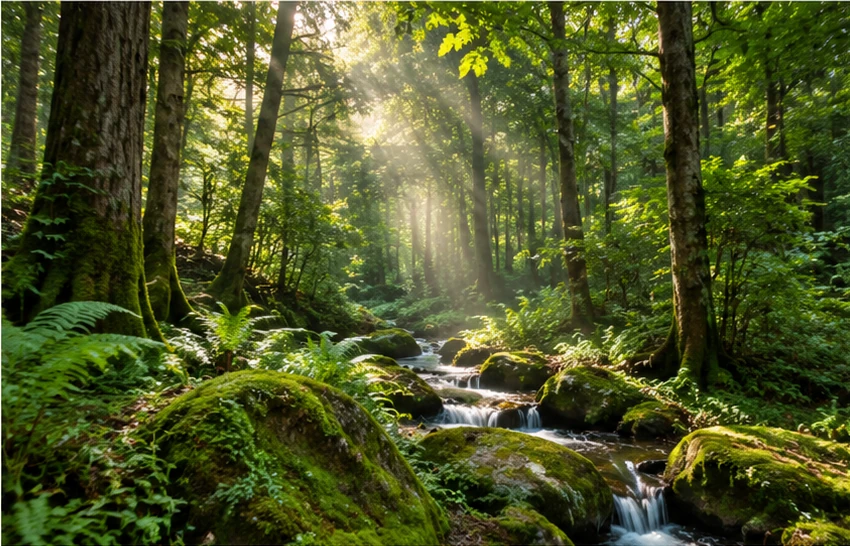
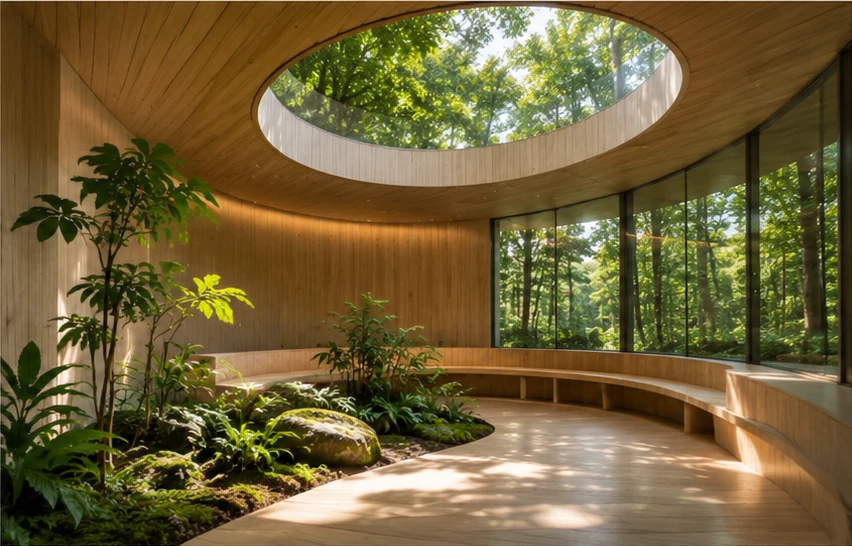
Forests combine numerous environmental influences. FSRL asks whether selected characteristics can be described, reproduced, and investigated in controlled architectural settings—not simply recreated in appearance.
Three distinct lines of inquiry
Controlled-environment research
A proposed experimental program examining environmental variables and their relationships with physiological, cognitive, behavioral, and experiential outcomes.
Structured human-state practice
An existing approach combining quiet, intention-directed reflection with focused touch or acupressure, documented separately from the proposed environmental research.
Observational case studies
Participant accounts and experiential reports that may generate research questions but do not, by themselves, establish mechanisms or clinical effectiveness.
The central research challenge
Can environmental conditions be specified, compared, and eventually replicated in ways that produce measurable and reproducible changes in human states?
FSRL approaches this question through a developing sequence:
- Define
- Measure
- Compare
- Explain
- Test
- Replicate
The objective is not to prove a theory. It is to find out what happens.
Explore the Method